Key Takeaways
-
Tower and reformer Pilates share the same foundations, but the equipment changes how the workouts feel.
-
Reformer Pilates is more dynamic because the moving carriage challenges stability, coordination, and full-body flow.
-
Tower Pilates is more controlled and precise since spring resistance comes from a fixed frame, making it great for form, posture, and targeted muscle work.
-
Space and comfort level matter: towers can be more space-efficient and feel more secure for beginners, while reformers typically require more room and have a higher learning curve.
-
Your best fit depends on your goals: choose reformer for variety and athletic progression, choose tower for alignment and focused strength, or combine both for the most versatile practice.
Pilates has evolved far beyond mat-based workouts. Today, two of the most popular apparatus-based practices are tower Pilates and reformer Pilates. Both offer strength, mobility, and low-impact conditioning, but they feel very different in practice and serve slightly different needs.
If you’re deciding between tower and reformer Pilates for studio classes or home practice, understanding how each system works can help you choose the option that best supports your body, space, and fitness goals. This guide breaks down the key similarities, differences, benefits, and limitations of each.
What Is Reformer Pilates?
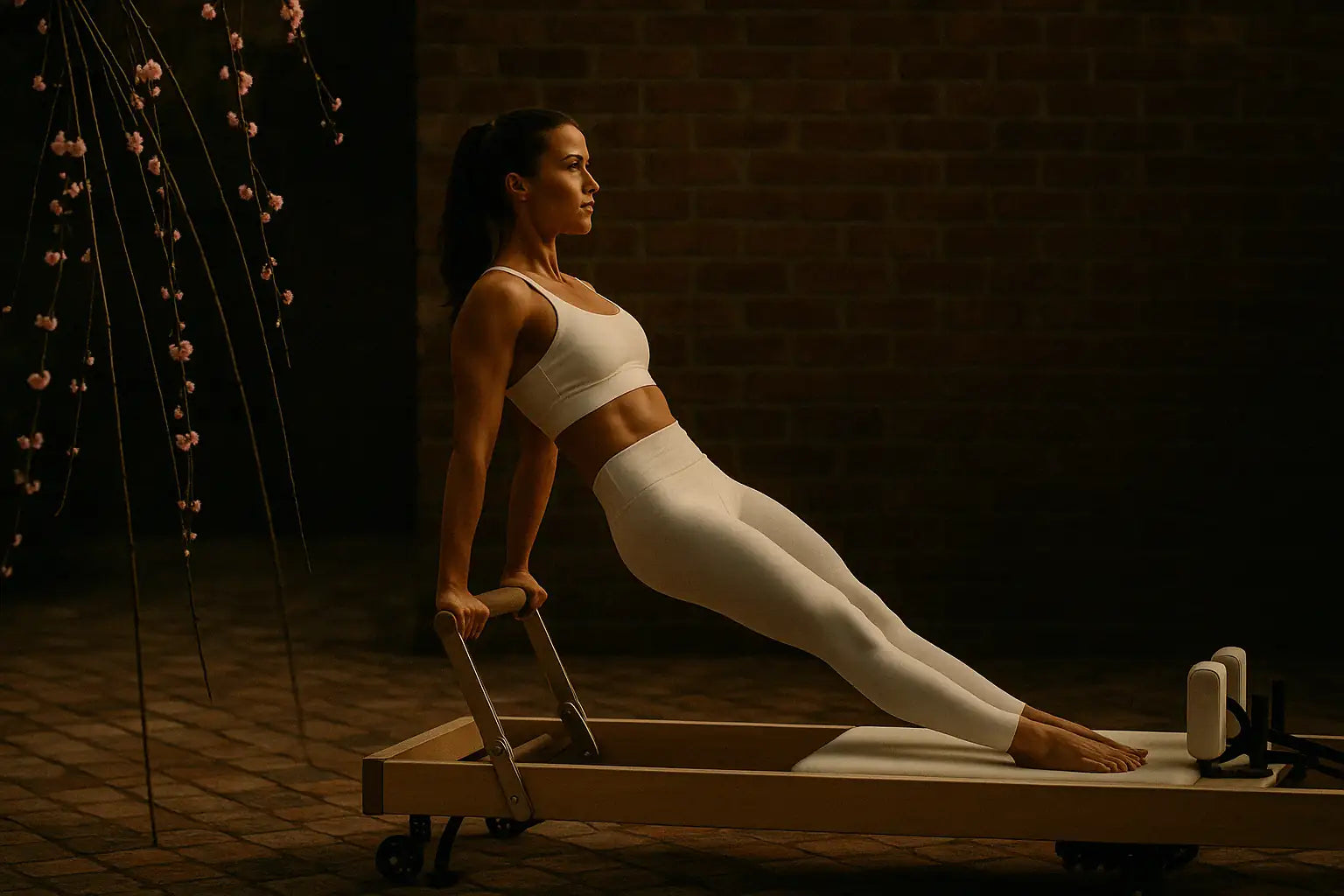
Reformer Pilates uses a sliding carriage system mounted on a frame with springs that provide adjustable resistance. The carriage moves back and forth as you perform exercises lying down, seated, kneeling, or standing.
Reformer Pilates is known for:
-
Dynamic, flowing movement
-
Resistance-based strength training
-
Full-body engagement through controlled motion
The moving platform of the Pilates reformer challenges stability and coordination while allowing for hundreds of exercise variations.
What Is Tower Pilates?
Tower Pilates uses a vertical or semi-vertical frame fitted with springs, bars, and straps. Exercises are performed against spring resistance that pulls from above, below, or the sides, rather than on a moving carriage.
Tower Pilates is often practiced:
-
On a wall-mounted tower
-
On a reformer with a tower attachment
-
On a mat with tower springs overhead
This setup emphasizes control, alignment, and precision.
Tower vs Reformer Pilates: Key Similarities
Despite their differences, tower and reformer Pilates share many foundational principles:
-
Low-impact, joint-friendly movement: Both systems use spring resistance instead of weights, which helps reduce joint strain while still building strength.
-
Core-focused training: Each approach emphasizes deep core engagement, posture, and spinal alignment throughout every movement.
-
Scalable for all levels: Tower and reformer Pilates can be modified to suit beginners, intermediate users, and advanced practitioners.
-
Full-body conditioning: Both methods work the entire body, including arms, legs, glutes, back, and stabilizing muscles.
If your goal is mindful, controlled strength training, either approach can deliver excellent results.
Tower vs Reformer Pilates: What’s the Difference?
Tower and reformer Pilates are built on the same foundations, but they create a different workout experience because the equipment changes how resistance is applied and how your body has to stabilize. The reformer’s moving carriage tends to feel more fluid and athletic, while the tower’s fixed springs often feel more grounded and technique-focused. Here’s how that difference shows up in movement style.
1. Movement Style
Both tower and reformer Pilates build strength and control, but the equipment changes the overall feel of the workout. Reformer Pilates tends to be more fluid and continuous because sequences often flow with minimal stopping, and the moving carriage adds a balance and coordination challenge that keeps stabilizing muscles engaged to control speed, range, and alignment.
Tower Pilates, on the other hand, feels more anchored and technique-driven since movements typically begin and end in clearly defined positions, and the fixed springs provide consistent, directional resistance without a moving surface, which encourages a slower, more deliberate focus on form, posture, and precise muscle activation.
2. Resistance Direction
While both methods use springs, the direction of resistance is a major difference, shaping whether the work feels more integrated or more targeted. On a reformer, resistance is primarily horizontal because the springs connect to the moving carriage, so many exercises involve controlled push-and-pull mechanics that feel similar to presses and rows and naturally recruit multiple muscle groups along with the stabilizers needed to manage the glide.
With tower Pilates, resistance can pull vertically, diagonally, or laterally depending on spring placement, which makes it easier to isolate specific areas like shoulder stabilizers, inner thighs, or deep abdominals, and the fixed point of tension helps reinforce clean movement patterns and posture-focused control.
3. Space and Equipment Needs
For many people, space becomes the deciding factor when choosing between tower vs reformer Pilates vs mat Pilates at home. Reformers typically require more room because the machine is long and you need clearance around it for safe, full-range movement, and even foldable home models can have a substantial footprint that requires storage planning and a bit of setup.
Tower setups are often more adaptable for smaller homes because they can be wall-mounted or used with a mat-based configuration, and they can also be added to a reformer as an attachment to create a two-in-one system that expands your exercise options without needing separate equipment, which is especially helpful in shared or multipurpose rooms.
Advantages of Reformer Pilates
Reformer Pilates is popular for a reason. The moving carriage and spring system create a workout that can feel both athletic and supportive, with plenty of room to progress over time.
-
Dynamic, full-body workouts: The moving carriage adds a functional challenge that builds coordination, balance, and muscular endurance.
-
Wide exercise variety: Reformer Pilates has one of the largest exercise libraries in Pilates, which keeps workouts fresh and supports long-term practice.
-
Strong strength-building potential: Adjustable springs make it easy to increase resistance gradually, helping you build strength as your technique improves.
-
Familiar studio experience: Many people are introduced to Pilates through reformer classes, so the format often feels comfortable and intuitive.
Limitations of Reformer Pilates
Reformer Pilates offers a lot, but it is not always the simplest setup for every lifestyle. These are the most common drawbacks to consider before committing to a reformer-based routine.
-
Requires more space: Even compact or foldable reformers need enough floor space during workouts, plus a plan for storage when not in use.
-
Can feel intimidating at first: The moving carriage adds instability, which may be challenging for total beginners until they learn control and setup basics.
-
Higher upfront cost: A quality reformer is an investment, and studio classes can also be pricey if you are practicing regularly.
-
Setup and adjustments take time: Changing springs, straps, and positions can add friction if you prefer quick, minimal-fuss workouts.
Advantages of Tower Pilates
Tower Pilates is a great option if you like a slower, more technique-focused style of training. Because the resistance comes from a fixed frame, it can feel especially supportive for learning control and refining form.
-
Exceptional control and precision: Tower exercises make it easier to isolate specific muscle groups with clarity and intention.
-
Strong focus on posture and alignment: Fixed resistance helps you maintain clean form and consistent positioning throughout each movement.
-
Space efficiency: Tower setups are often more compact than full reformers, which can be ideal for smaller rooms or home studios.
-
Ideal for rehabilitation and beginners: The anchored nature of tower work can feel more stable and approachable for those new to Pilates or returning from injury.
Limitations of Tower Pilates
Tower Pilates can be incredibly effective, but it is not always the best match for everyone’s preferences or training goals. Here are the most common trade-offs to keep in mind.
-
Less dynamic movement: Some people find tower workouts feel less fluid or less cardio-adjacent than reformer sessions.
-
Smaller exercise range: While versatile, tower systems typically offer fewer movement patterns than a full reformer setup.
-
May feel repetitive for advanced users: Experienced practitioners sometimes miss the added challenge and variety that comes from controlling a moving carriage.
Tower vs. Reformer Pilates: Which Is Best for You?
If you’re deciding between tower and reformer Pilates, it helps to think about how you like to move, what you want to improve, and what your space and routine realistically allow. Both options can deliver excellent results, but they shine in different ways, so the “best” choice is usually the one you’ll enjoy enough to stick with.
Choose reformer Pilates if you:
-
Enjoy dynamic, flowing workouts that feel more continuous and movement-based.
-
Want variety and progression over time, with lots of exercise options to keep your practice fresh.
-
Prefer a more athletic Pilates experience, where the moving carriage challenges balance and coordination.
-
Plan to practice regularly and build strength, using spring resistance to steadily level up.
Choose tower Pilates if you:
-
Prefer controlled, deliberate movement with a more grounded, technique-forward pace.
-
Want to focus on posture and alignment, since the fixed frame can make form easier to maintain.
-
Have limited space, and need a setup that feels more flexible for a home environment.
-
Are new to Pilates or returning from injury, and want something that often feels more stable and approachable.
Consider both if you:
-
Want maximum versatility and like having more than one training style available.
-
Practice Pilates long-term and want your workouts to evolve with your body and goals.
-
Are setting up a home studio and want the broadest range of exercises without buying two separate systems.
Many practitioners find the best solution is an affordable Pilates reformer that can be paired with a tower, so they can alternate between the reformer’s dynamic carriage work and the tower’s precision-based spring exercises depending on their mood, goals, or recovery needs.
Can You Do Tower and Reformer Pilates at Home?
Yes. Modern Pilates equipment is designed specifically to support home use, including compact reformers and reformers with tower attachments that combine both systems into a single setup. This makes it possible to practice both tower and reformer Pilates without needing a dedicated studio or multiple machines.
For many home practitioners, versatility matters more than choosing one method exclusively. Being able to switch between dynamic reformer workouts and more controlled tower-based sessions allows your practice to adapt to your energy level, space, and physical needs. It can also make home Pilates feel more sustainable long term, since you’re not locked into a single style as your body and goals evolve.
This flexibility is especially valuable if you share your space, train at different intensities throughout the week, or want equipment that can grow with you over time.
Final Thoughts: Tower vs. Reformer Pilates
Tower and reformer Pilates are not competing practices. They are complementary systems built on the same principles, each offering unique benefits.
Reformer Pilates excels at dynamic, full-body movement and long-term progression. Tower Pilates shines in control, alignment, and targeted strength. The best choice depends on how you like to move, the space you have, and what you want from your practice.
For many people, the most effective solution is having access to both. That flexibility allows Pilates to evolve with your body, your schedule, and your goals. Explore our list of the best Pilates reformer machines.
Tower vs Reformer Pilates FAQs
Is Pilates Tower better than Reformer for weight loss?
Tower Pilates can support weight loss by building strength and improving muscle tone, but reformer Pilates often feels more dynamic and may burn more calories due to continuous movement and higher overall intensity.
Which form of Pilates is most effective?
The most effective form of Pilates is the one you can practice consistently, whether that is mat, reformer, or tower, since all build strength, mobility, and core control when done regularly.
Which type of Pilates is best for weight loss?
Reformer Pilates is often considered the best type for weight loss because it allows for longer, flowing sequences that engage multiple muscle groups at once, though tower Pilates can still contribute when paired with consistent practice.
Is Tower Pilates good for you?
Yes, tower Pilates is very good for improving posture, core strength, and muscle control, and it is especially helpful for beginners, rehabilitation, or anyone who prefers a more controlled and alignment-focused workout.